$db.technews_
Latest NewsArtificial IntelligenceSoftware DevelopmentConsumer TechCybersecurityStartupsBig TechTech PolicyEmerging TechDigital CultureEnterprise & Cloud Infrastructure
$db.technews_
Latest NewsArtificial IntelligenceSoftware DevelopmentConsumer TechCybersecurityStartupsBig TechTech PolicyEmerging TechDigital CultureEnterprise & Cloud Infrastructure
Admin Portal
/technology/2026-09-17-geomeego-introduces-new-era-travel

#GeomeeGo Introduces a New Era in Travel Booking with Enhanced Accountability

author
dbtechnews
committed
2026-09-17 09:22 UTC
topic
Technology
read
~7 min

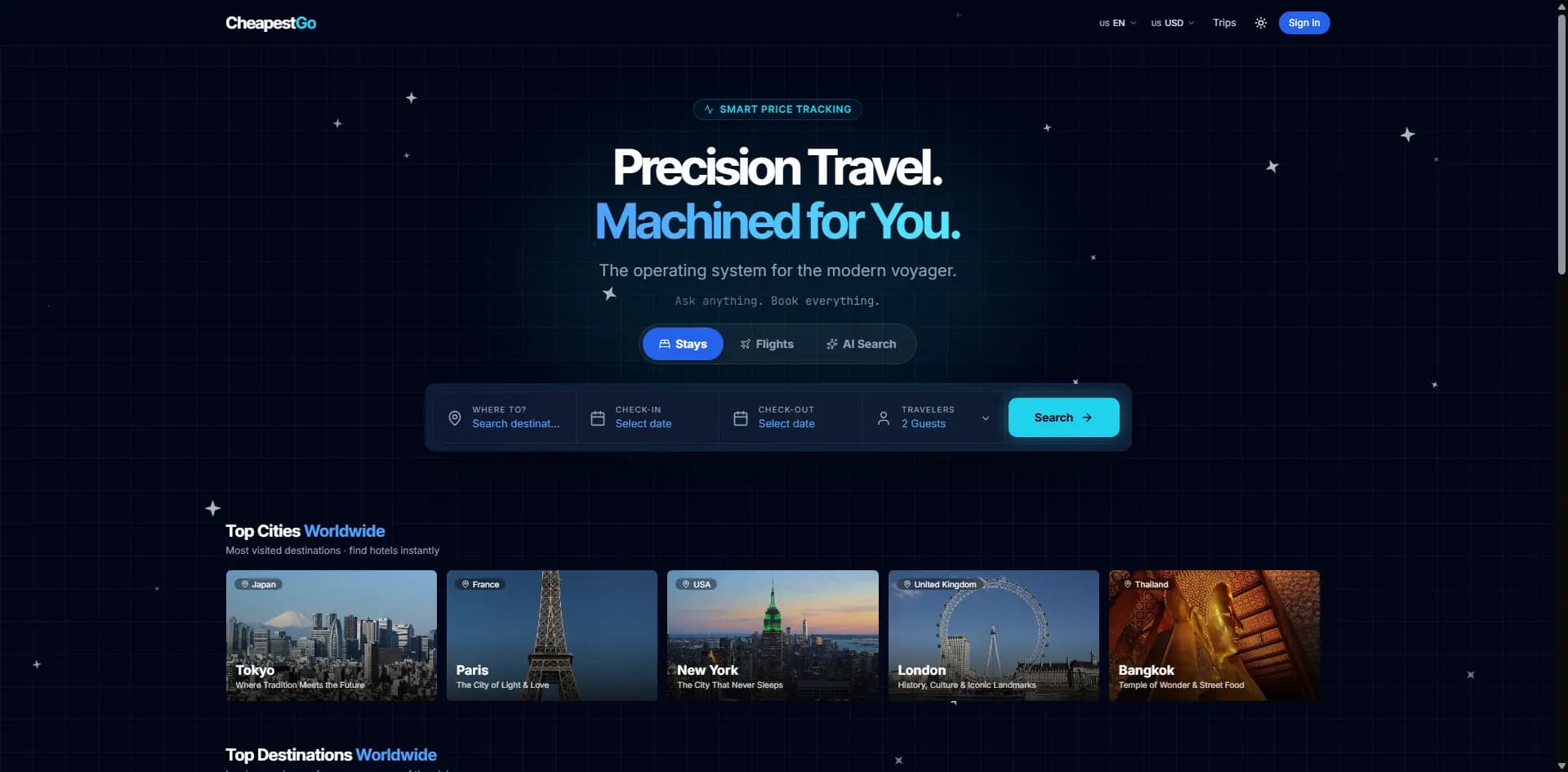
GeomeeGo has emerged as a cutting-edge search and booking platform designed around real-time inventory. It utilizes live flight options from Duffel and hotel listings from TravelgateX,…

GeomeeGo Introduces a New Era in Travel Booking with Enhanced Accountability
// dbtechnews

GeomeeGo has emerged as a cutting-edge search and booking platform designed around real-time inventory. It utilizes live flight options from Duffel and hotel listings from TravelgateX, alongside a robust price-tracking system that monitors routes across various airlines and accommodations in real-time. The platform follows a streamlined process: search, compare, and book, ensuring instant confirmation and secure checkout.

This foundational aspect of the service is only the beginning, as questions arise about what lies ahead for GeomeeGo.

The company characterizes itself as the operating system for today's travelers, promoting the idea: "ask anything, book everything." This concept suggests a platform with capabilities exceeding a simple search interface; it aims to manage users' goals, gather pertinent data, act on their behalf, and provide transparency about its actions afterward. This aspirational framework sets a standard that many existing AI travel solutions have yet to achieve, particularly with the introduction of the Structured Cognitive Loop (SCL).

There are notable issues with the current state of AI travel agents. Most booking assistants rely on a uniform architecture where a single large language model performs multiple tasks: managing user requests, recalling previous conversation details, determining search algorithms, interpreting results, and effectuating booking—all within a linear text stream.

While this approach demonstrates potential during demonstrations, it has recurrent shortcomings during actual use cases. As dialogues extend, earlier details may dissipate, leading to ambiguous branching conditions. The model might miss a necessary step or, conversely, duplicate actions. Most critically, if an error occurs—such as booking the incorrect fare class, mistaking dates, or making a non-refundable reservation without prior confirmation—there remains a lack of clarity in understanding the reasoning behind the model's decisions.

In the realm of travel, the stakes are undeniably high. Confirming a booking involves a financial undertaking tied to genuine inventory and significant cancellation fees. Accepting that "the model was mostly correct" is unacceptable when real money is at stake.

The integration of Structured Cognitive Loop is poised to address these issues. SCL represents a cognitive framework aimed at dividing responsibilities into specialized sectors rather than collapsing them into a singular model. This division permits organized functions such as:

- Retrieval, where the information pool is established at the outset of a decision-making process rather than accumulated during reasoning.

- Cognition, where the language model suggests actions but does not possess the authority to make final decisions.

- Control, wherein specific algorithms check proposed actions against predefined criteria, preventing invalid actions from being executed and eliminating the need for post-facto apologies.

- Human oversight, allowing a person to confirm critical decisions at the moment judgment is required.

- Action, where only proposals that meet approval go into effect.

- Memory, which retains verified facts while discarding unproven context.

This architecture underscores a crucial principle: the model functions as a judgment mechanism within a structured loop. Enhanced coordination, rather than merely enlarging the model's size, leads to substantial advancements.

Two significant implications of this approach pertain to travel:

First, the delineation between proposals and execution is essential. Traditional agents may delegate booking decisions and subsequent confirmations to the same system. With SCL, every proposal must successfully pass a verification stage before it becomes an authorizing action. For instance, an agent can recommend a rebook when your connecting flight is altered, yet the actual ticket is only secured after approval under acceptable conditions.

Second, each decision made within the system generates a record. Instead of attempting to reconstruct plausible explanations post-event, SCL maintains a running log that captures the decision-making pathway in real-time. This includes the evidence considered, rules invoked, approvals granted, and actions taken. This transparency is invaluable to travelers who seek to understand decisions about their bookings, moving away from frustrating experiences where "the AI booked something unusual" towards clear, accountable reasoning. This level of traceability is also paramount for partnerships with agencies and enterprises, especially in light of evolving regulations like the EU AI Act.

What does this capability facilitate?

Once decisions are neatly organized, a variety of functionalities arise that could be haphazard in a monolithic agent:

Maintaining a standing intent hallmark. The user can articulate their desires—for example, a trip to Bangkok in late October, costing less than $600, requesting an aisle seat, and a hotel within walking distance from the BTS rail line. The SCL loop captures this intent over time as prices fluctuate, analyzing options against stated parameters to highlight the best match along with the rationale.

Shifting price monitoring to proactive engagement. The framework not only observes price changes but can act on them too. The system evaluates offers, suggests actions, and pauses for user agreement before any expenses occur. This model allows for autonomy in less critical areas while ensuring human control over significant financial decisions.

Effectiveness in orchestrating complex itineraries. Arranging trips involving multiple flights, hotels, car rentals, and connections across various cities can easily confuse agents driven by conversational context alone. By anchoring responses to confirmed facts instead of expanding historical dialogues, the system ensures greater stability in travel plans.

Accessible disruption management. In instances such as a last-minute flight cancellation, a proficient agent should be able to propose, confirm, and document an alternative booking path, which is significantly more valuable than merely offering advice.

Looking forward, the travel commerce landscape is poised for a transformation from searching to delegating. For more than two decades, travelers have independently sifted through available options. The emerging trend is to declare a destination, budget, seating preference, and desired neighborhood, letting the system take charge of optimizing these reservations as prices change.

However, successful delegation hinges on trust. Users must believe that agents will engage in responsible spending practices. An agent enabling financial transactions without a transparent accounting of actions presents a risk rather than an asset. The prevailing challenge for agent-driven travel will be accountability, not merely capabilities. Platforms competent in demonstrating their decision-making processes will be the ones travelers and partners are willing to entrust with their bookings.

Traceability is expected to transition from a competitive edge to a fundamental requirement in travel technology, driven by consumer trust and the compliance needs of agency and enterprise stakeholders. GeomeeGo aims to establish this benchmark rather than merely respond to it later.

According to Jun Shin, Chief Executive Officer of FORHU Inc., "Travel is going to be booked by agents rather than by people clicking through search results. What nobody in this industry has answered is who is accountable when one of those agents gets it wrong, and we don't think that answer can live in the terms of service it has to be in the architecture. That's why we're building GeomeeGo around a loop where the model proposes and the system decides, and why we'd rather ship it in stages and be able to show our work."

In closing, it is essential to note the scope of their ambitions. While GeomeeGo is not positioning itself as an infallible AI, it acknowledges that errors are inherent in generative reasoning. The practical ambition lies in ensuring that misjudgments do not translate into costly financial transactions. This design goal is controlled, governed, and traceable with human oversight.

Integration of SCL within GeomeeGo is slated for future rollout, currently absent in production. Implementation will proceed gradually, starting with search and monitoring layers, before advancing to booking functions, with a commitment to transparency throughout the process.

GeomeeGo stands as a global booking platform tailored for discerning travelers, offering live inventory through Duffel and TravelgateX, with extensive reach across Asia-Pacific and beyond, promising precise data and unwavering quality. Information can be found at geomeego.com.

SCL outlines a framework for accountable AI by segmenting cognition, memory, control, and execution into distinct, traceable segments. This methodology is referenced in peer-reviewed and preprint materials, including the papers "Structured Cognitive Loop for Behavioral Intelligence in LLM Agents" and "Bridging Symbolic Control and Neural Reasoning in LLM Agents."

For media inquiries, Jun Shin can be reached at marketing@forhu.ai or at +1 646-921-7861 in New York, NY, United States. Additional information is available at geomeego.com and forhu.ai.

Share this article

> related

    01
    Technology

    Explore the AI Consultation Feature of Ilovelawyer

    02
    Technology

    Ilovelawyer: Enhancing Coordination in Legal Practices

    03
    Technology

    Ilovelawyer Transforms Legal Practice Through AI-Driven Case Management

    04
    Technology

    FORHU Inc. Defines the Future of Enterprise AI Governance at VivaTech 2026

    05
    Technology

    Forhu: Pioneering a Transparent Future for Artificial Intelligence

$db.technews_

Infrastructure, data, and the systems that run everything else.

»Sections
  • Home
  • All Stories
  • Archive
  • Contact
»Topics
  • Artificial Intelligence
  • Software Development
  • Consumer Tech
  • Cybersecurity
  • Startups
»Newsletter

The day's technology headlines, in your inbox each morning.

© 2026 DbTechnews. All rights reserved.

PrivacyTermsCookies